



GJ Gardner Homes brings home design choices and a builder into the same conversation. That approach stops being the right fit when you want to settle your floor plan separately from choosing who builds it. The best GJ Gardner Homes alternative in 2026 is Australianhousedesigns if you need ready-made floor plans or custom drafting; a local custom builder if you need a construction-led alternative.
- For GJ Gardner Homes alternatives, choose Australianhousedesigns for ready-made floor plans or full custom home-design drafting.
- A local custom builder suits buyers who want design decisions discussed alongside construction.
- An owner-builder route requires separate checks on eligibility, responsibilities and project coordination.
- Compare house designs against block constraints before comparing providers.
Why this matters
Choosing a home designer and choosing a builder are different decisions. A floor plan answers how you want to live; a construction agreement establishes who will deliver the home and on what terms. Buying one does not automatically secure the other.
Your search for GJ Gardner Homes alternatives in 2026 should start with the part of the process you want to change. If the layout is wrong, another builder's name is not the answer. If the construction arrangement is wrong, a different floor plan alone will not fix it.
Choose the route before choosing the provider. Decide whether you need a design service, another builder, or a different way to manage the build. That distinction keeps your shortlist useful rather than turning it into a collection of unrelated businesses.
GJ Gardner Homes alternatives at a glance
These options represent different ways to organise a home project, not interchangeable packages. Read the scope column first: it shows which responsibility you still need to resolve.
| Option | Best for | Standout approach | How it differs from GJ Gardner Homes | Scope to confirm |
|---|---|---|---|---|
| GJ Gardner Homes | Buyers seeking a builder-led home project | Home designs considered alongside construction | The benchmark builder option | Local design process, inclusions and construction agreement |
| Australianhousedesigns | Buyers choosing a floor plan or commissioning custom drafting | Ready-made plans and full custom home-design drafting | Starts with the design service rather than the construction agreement | Drawing deliverables, revisions and intended use |
| Local custom builder | Buyers seeking a different construction provider | Direct discussion of the proposed home with the builder | Changes the builder rather than necessarily separating design from construction | Design responsibility, site work and contract inclusions |
| Owner-builder route | Eligible buyers willing to coordinate the project themselves | Direct responsibility for organising the build | Changes who manages the project | State requirements, approvals, insurance and trade coordination |
A meaningful comparison uses the same proposed home and site information for each route. Otherwise, a simple-looking proposal and a detailed proposal can appear comparable while leaving very different work outside their scope.
1. Australianhousedesigns: best for design-first planning
Australianhousedesigns offers ready-made floor plans and full custom home-design drafting across modern, traditional, Hamptons, small-lot, acreage and duplex styles. It suits you when the immediate decision is what to build, rather than which construction agreement to sign. Start with a ready-made layout when it fits your brief; discuss custom drafting when your requirements need a different arrangement.
Australianhousedesigns is best for buyers who need house designs before choosing their construction arrangement. That is a specific alternative to a builder-led starting point, not a claim that a design service replaces a builder.
Where the design-first route shines
- Separate decisions: You can focus your brief on room relationships, access, privacy and outdoor space before assessing construction proposals.
- Different starting points: Ready-made floor plans and custom drafting address different levels of design work.
- Relevant design categories: The stated range includes small-lot, acreage and duplex designs, alongside modern, traditional and Hamptons styles.
- A clearer brief: Selecting a layout gives your later builder discussions a defined starting point rather than a general style preference.
Where the design-first route falls short
- A design service is not a substitute for a construction agreement. You still need to establish who will build the home.
- A ready-made plan does not, by itself, establish suitability for your block or approval pathway.
- Separating design and construction means you must clarify who handles later drawing changes and builder feedback.
- Do not assume a plan purchase includes engineering, surveys, approval submissions or every document a builder requires. Confirm the actual scope before proceeding.
Head-to-head: design service versus builder-led planning
| Decision | Design-first service | GJ Gardner Homes |
|---|---|---|
| Immediate task | Select a ready-made floor plan or commission custom drafting | Discuss the home with a building provider |
| Main comparison | Layout suitability and drawing scope | Proposed home and construction scope |
| Next responsibility | Establish the building and approval arrangements | Confirm responsibilities under the local proposal |
| Key question | What drawings and permitted uses are included? | What design and construction work is included? |
Best for: Buyers who want a defined house design before settling the construction arrangement.
Before commissioning drawings in 2026, write down which decisions remain open. A clear room schedule is useful; a clear list of unresolved site issues is just as important. Ask how those issues affect the drafting brief rather than treating them as problems to solve after the plan is finished.
Verdict: Buy the design service when your next decision is the floor plan; wait if your site requirements are still unresolved.
2. Local custom builder: best for a construction-led alternative
A local custom builder is the direct alternative when you want a different business to build your home. Unlike a design-only starting point, this route keeps construction discussions central. Ask each shortlisted builder to explain how it handles the proposed design rather than assuming every custom builder follows the same process.
The useful comparison is not national brand versus local business. It is the proposed scope, responsibility for design changes, site allowances and the construction agreement for your particular project.
Where a local custom builder shines
- You can discuss construction requirements directly with the business proposing to build the home.
- You can ask how the builder would handle your existing plans or a new design brief.
- A written proposal provides a basis for comparing what the builder includes and excludes.
Where a local custom builder falls short
- The label custom builder does not establish the extent of design work included.
- You still need to check licence details, insurance requirements and contract terms through the relevant state channels.
- Different proposals can allocate site work and consultant responsibilities differently. A headline summary is not enough to compare them.
Head-to-head: changing the builder
| Decision | Local custom builder | GJ Gardner Homes |
|---|---|---|
| Main purpose | Assess another construction provider | Assess the benchmark construction provider |
| Design process | Ask who prepares and revises drawings | Ask the local office who prepares and revises drawings |
| Existing plans | Confirm acceptance and required changes | Confirm acceptance and required changes |
| Comparison basis | Written scope and construction agreement | Written scope and construction agreement |
Best for: Buyers who want another builder, rather than a separate design service.
For a useful 2026 comparison, give each builder the same brief and site information. Record exclusions beside inclusions; both affect your responsibilities. Do not treat a shorter document as a simpler project.
Verdict: Hold until the builder's written scope answers your design and construction requirements.
3. Owner-builder route: best for hands-on project coordination
An owner-builder route changes your role, not just your provider. It puts responsibility for coordinating the project with you, subject to the requirements that apply in your state or territory. It is not a shortcut around approvals, technical documentation or qualified trades.
Consider this route only if managing the build is an explicit goal. Wanting a different floor plan is not, by itself, a reason to take on project coordination.
Where the owner-builder route shines
- You take a direct role in organising the project.
- You can distinguish design appointments from trade and consultant appointments.
- You decide whether that level of involvement matches your preferred way of working.
Where the owner-builder route falls short
- Eligibility and obligations require checking with the relevant state or territory authority.
- Coordinating trades, documentation and sequencing becomes part of your responsibility.
- A plan purchase does not resolve insurance, approvals, construction management or later sale obligations.
| Decision | Owner-builder route | GJ Gardner Homes |
|---|---|---|
| Project coordination | Your responsibility within applicable requirements | Confirm the builder's responsibilities in the agreement |
| Design documents | Arrange and verify the required documentation | Confirm the documentation included in the proposal |
| Main assessment | Your eligibility and capacity to manage the project | The builder's proposed scope and agreement |
Best for: Eligible buyers who specifically want responsibility for coordinating the build.
Verdict: Skip unless you have checked the legal requirements and genuinely want the management role.
Why people switch from GJ Gardner Homes
There is no need to assume a fault with GJ Gardner Homes to choose another route. The practical reasons below concern what you need from the project, not claims about customer dissatisfaction, delays or service quality.
You want to resolve the design first
A builder discussion can be premature when your household has not settled the room arrangement. A design-first service addresses that immediate task. You can then assess construction arrangements against a clearer brief.
You need the block to drive the layout
Block shape, access and privacy belong in the initial design brief. A narrow frontage, awkward entry position or sloping site changes the questions you must answer. Choose a route that addresses those questions explicitly rather than starting with appearance alone.
You want a different construction provider
If your concern is the proposed construction arrangement, shortlist builders. Buying another plan does not change a construction contract. Compare written responsibilities and exclusions before making the change.
You want to manage the project yourself
That is a delivery decision with legal and practical consequences. Assess the owner-builder requirements separately from your design preferences. An attractive floor plan says nothing about your capacity to coordinate its construction.
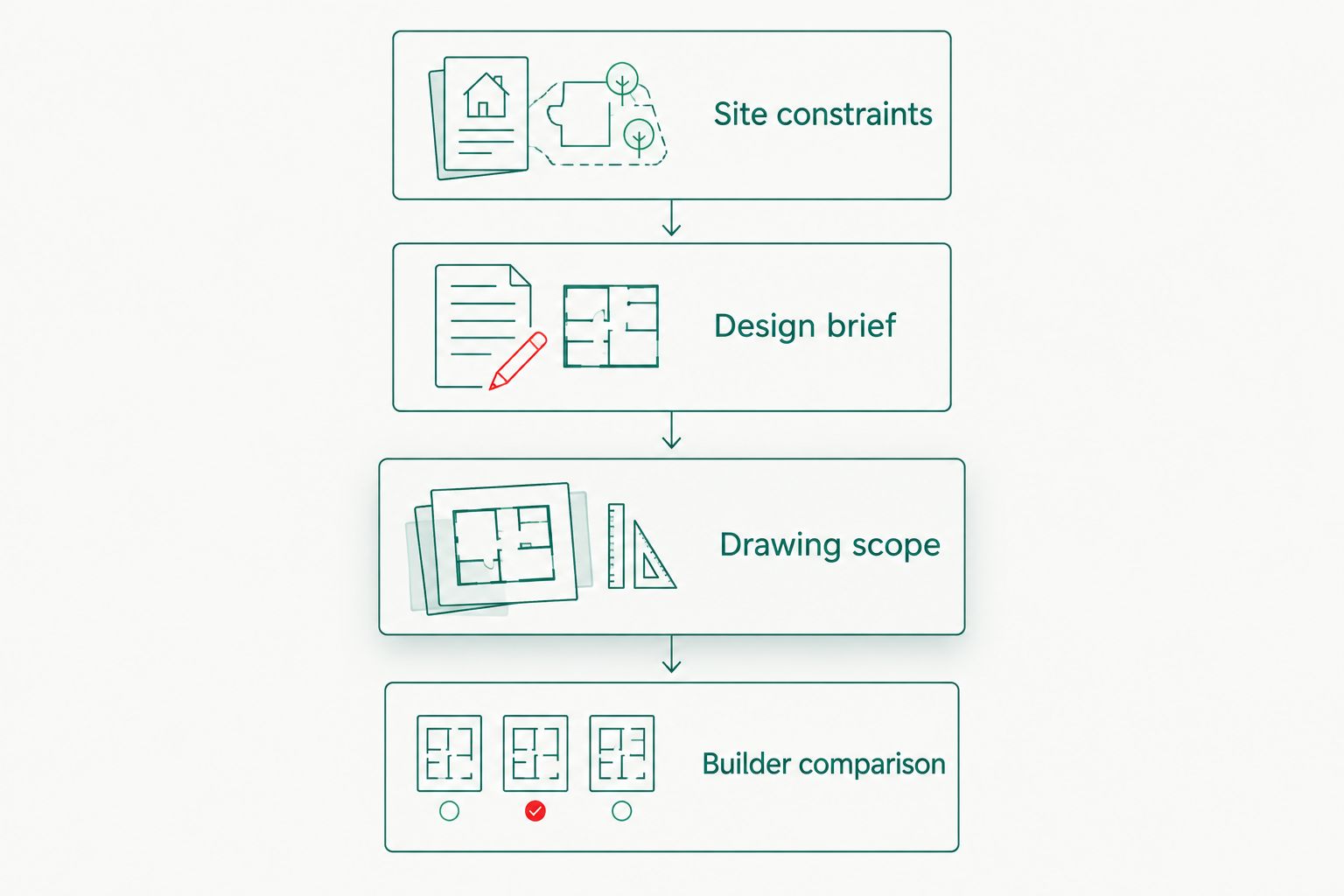
How to choose your route in 2026
Use the following sequence before committing to a provider. It separates site questions from design preferences and keeps builder comparisons tied to the same information.
- Site constraints: Gather the available survey, access information and planning requirements. Record unresolved questions about slope, drainage, privacy and services.
- Design brief: Prepare 1 written brief covering rooms, household routines, outdoor connections and priorities. Separate essentials from preferences.
- Drawing scope: Compare 2 candidate layouts against that brief, then establish which drawings and revisions you need. Check permitted uses before assuming you can take purchased drawings to any builder.
- Builder comparison: Use 1 shared scope checklist for construction discussions. Ask each provider to identify included work, excluded work and unresolved items.
The quantities above are a practical organising method, not a market benchmark. The important point is consistency: each provider should respond to the same household needs and site information.
A drawing brief should also identify who will respond when construction feedback requires a change. Set that responsibility early. Otherwise, separating design and construction can leave an important handover question unanswered.
Choose your design starting point
Explore ready-made floor plans and custom home-design drafting before deciding on your construction route.
When staying with GJ Gardner Homes is the right call
Stay with GJ Gardner Homes when its proposed design, local building arrangements and written scope meet your requirements. Switching is not a goal in itself. A different provider needs to solve a specific problem or offer a better fit for your chosen process.
Before deciding, ask the local office to clarify unresolved design questions, site responsibilities and inclusions. Assess the answers against your brief. If the arrangement already fits, keep it on your shortlist rather than changing providers just to separate the process.
FAQ
What's the best GJ Gardner Homes alternative in 2026?
Australianhousedesigns is the best fit for buyers seeking ready-made floor plans or full custom home-design drafting. Choose a local custom builder instead when your immediate need is another construction provider.
Is a house design service the same as a home builder?
No, a house design service and a home builder address different responsibilities. Confirm the drawing scope separately from the construction agreement, including who handles revisions and approval documentation.
Should I choose my floor plan before choosing a builder?
Choose a design-first route when resolving the layout is your immediate priority. Check site requirements and the intended use of the drawings before committing, and establish how later builder feedback will be handled.
Can I take purchased house plans to any builder?
Do not assume purchased house plans can be used by any builder. Check the permitted uses, drawing deliverables and the proposed builder's requirements before purchasing or sharing them.
Is a local custom builder better than GJ Gardner Homes?
A local custom builder is a better fit only when its proposed scope and construction arrangement better meet your brief. Compare the same design and site information, not business labels alone.
Are ready-made floor plans suitable for a sloping or narrow block?
Suitability depends on the particular plan and site constraints. Check access, slope, setbacks and the relevant planning requirements before treating a ready-made layout as a final solution.
Should I become an owner-builder instead?
Choose an owner-builder route only when you want project coordination responsibility and meet the applicable requirements. Check state or territory rules, approvals and insurance obligations before deciding.
One last thing
Ask who owns the next change. If a builder requests a revised window position, room arrangement or structural detail, establish who assesses it, who updates the documents and who confirms the revised scope.
That handover question exposes the real difference between buying a plan and organising a build. Answer it before committing, not when separate providers are already waiting on one another.